Cite this article:
Bai, R.#; Chen, J. #; Lin, J.; Ma, W.; He, J.; Liu, C.; Zhou, S.; Yuan, M.*; Zhang, J*. Strong dipole-dipole interaction promotes electrocatalytic acetylene semihydrogenation over symmetric organo-electrocatalysts. J. Am. Chem. Soc. 2026.
https://doi.org/10.1021/jacs.6c03900
1.Introduction
Ethylene, one of the most crucial chemical feedstocks, is extensively utilized in manufacturing polymeric materials (rubber, fibers and synthetic plastics) and commodity chemicals (e.g., ethanol and vinyl chloride), and its global annual production reaches approximately 200 million tons. However, current ethylene feedstocks produced through petroleum cracking inevitably contain trace acetylene impurities, which severely poison the catalysts for downstream ethylene polymerization reactions. Therefore, the removal of acetylene impurities from crude ethylene is extremely necessary. Recently, room-temperature electrocatalytic acetylene semihydrogenation (EAH) using water as the hydrogen source represents a highly promising solution. At present, Cu-based catalysts is a primary research focus in EAH. Nevertheless, their catalytic performance is governed by multiple complex factors, including crystal facet, size, and defects. These complex interactions hinder the investigation of structure−activity relationships and the underlying electrocatalytic mechanisms. Conversely, metal-free organocatalysts offer well-defined active sites and tunable molecular structure, permitting precise mechanistic investigations without multi-factor interference. Howevern, the intrinsic interaction between these catalysts and reactants (e.g., nonpolar acetylene molecules) remains poorly understood, which restricts their further development.
2.Summary of Research Findings
Professor Jian Zhang’s group innovatively proposed a new strategy for enhancing the dipole–dipole interaction between catalysts and acetylene by regulating the symmetry of organic molecules. By using a series of fluorobenzoic acids (FBA) as model catalysts, the team constructed molecular electrocatalysts with tunable symmetry by regulating the substitution number/position of fluorine. It was found that fluorobenzoic acids featuring symmetric π-π conjugation, such as 2,4,6-trifluorobenzoic acid (2,4,6-TFBA), exhibited substantially higher catalytic activity than their asymmetric isomers. The operando spectroscopic studies, electrochemical analyses and theoretical simulations together revealed that the highly symmetric molecular structure increases dipole magnitude and further strengthens total dipole moment with acetylene. The induced strong dipole–dipole interaction linearly reduces the energy barrier of acetylene adsorption on fluorobenzoic acid and effectively activates acetylene by polarizing the C≡C bond and redistributing the electron density of O− sites in carboxylate anion. Consequently, the optimal catalyst 2,4,6-TFBA affords a high ethylene Faradaic efficiency of 94.5% and an ethylene partial current density of 242 mA cm⁻2 at −0.9 V versus the reversible hydrogen electrode (RHE) under pure acetylene atmosphere, considerably surpassing the asymmetric fluorobenzoic acid analogues and previously reported electrocatalysts.
The research, titled “Strong dipole-dipole interaction promotes electrocatalytic acetylene semihydrogenation over symmetric organo-electrocatalysts” has been published in the top international chemistry journal Journal of the American Chemical Society (DOI: 10.1021/jacs.6c03900). The corresponding authors are Professor Jian Zhang and Associate Professor Menglei Yuan from State Key Laboratory of Solidification Processing and School of Materials Science and Engineering, and the first author is Ph.D candidate Rui Bai.
3.Graphical Overview
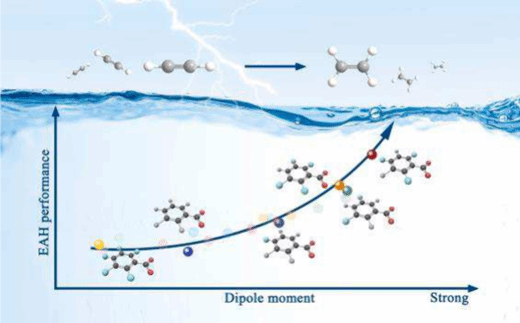
Figure 1. Strong Dipole−Dipole Interaction Promotes Electrocatalytic Acetylene Semihydrogenation over Symmetric Organo-Electrocatalysts.
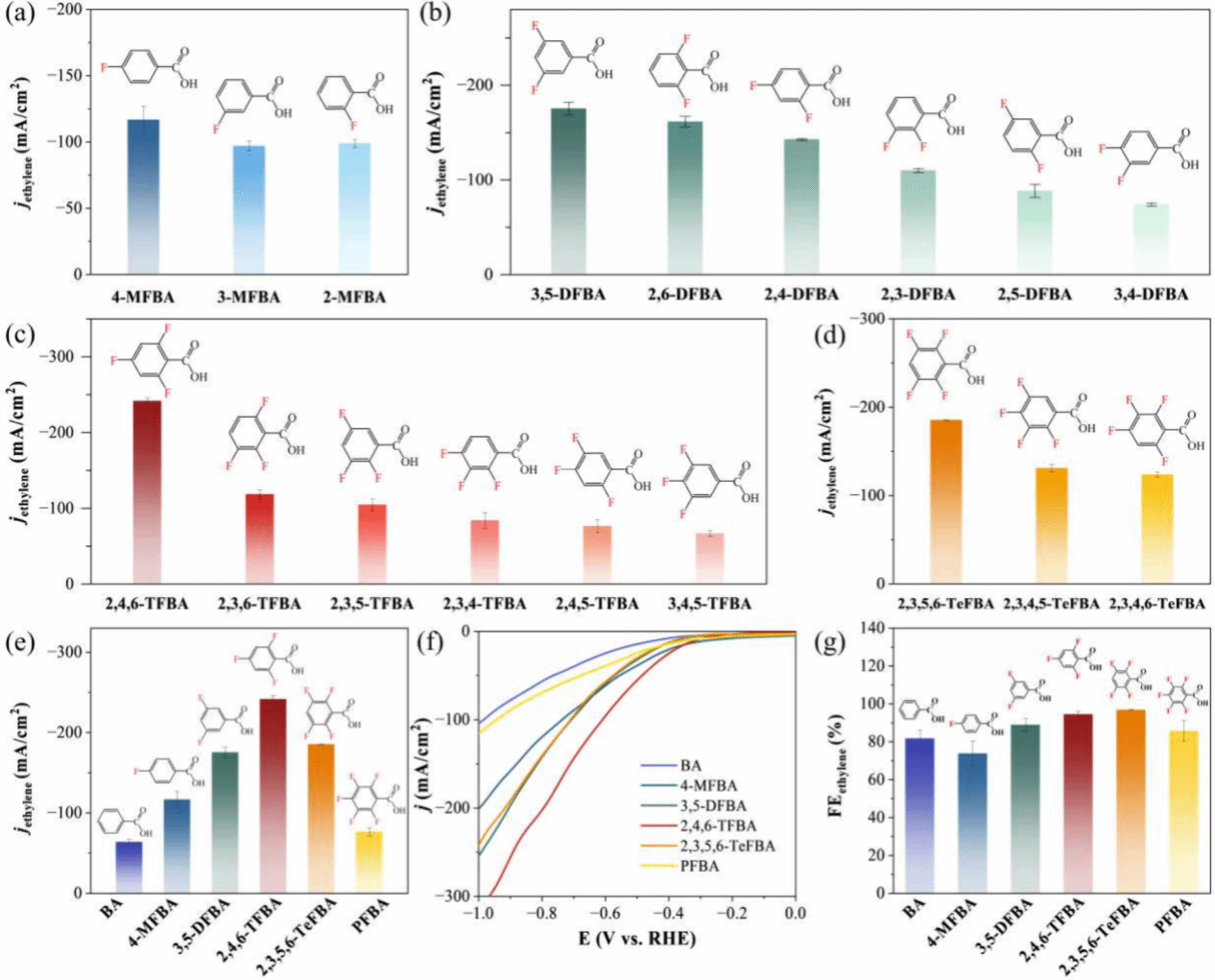
Figure 2. Electrocatalytic performance of FBA in a three-electrode flow cell. Comparison of ethylene partial current densities for (a) MFBA, (b)DFBA, (c) TFBA, and (d) TeFBA at −0.9 V in 1 M KOH aqueous solution under a pure acetylene stream. Comparison of (e) ethylene partial current densities, (f) polarization curves, and (g) Faraday efficiencies for BA, 4-MFBA, 3,5-DFBA, 2,4,6-TFBA, 2,3,5,6-TeFBA, and PFBA in 1 M KOH aqueous solution under a pure acetylene stream.
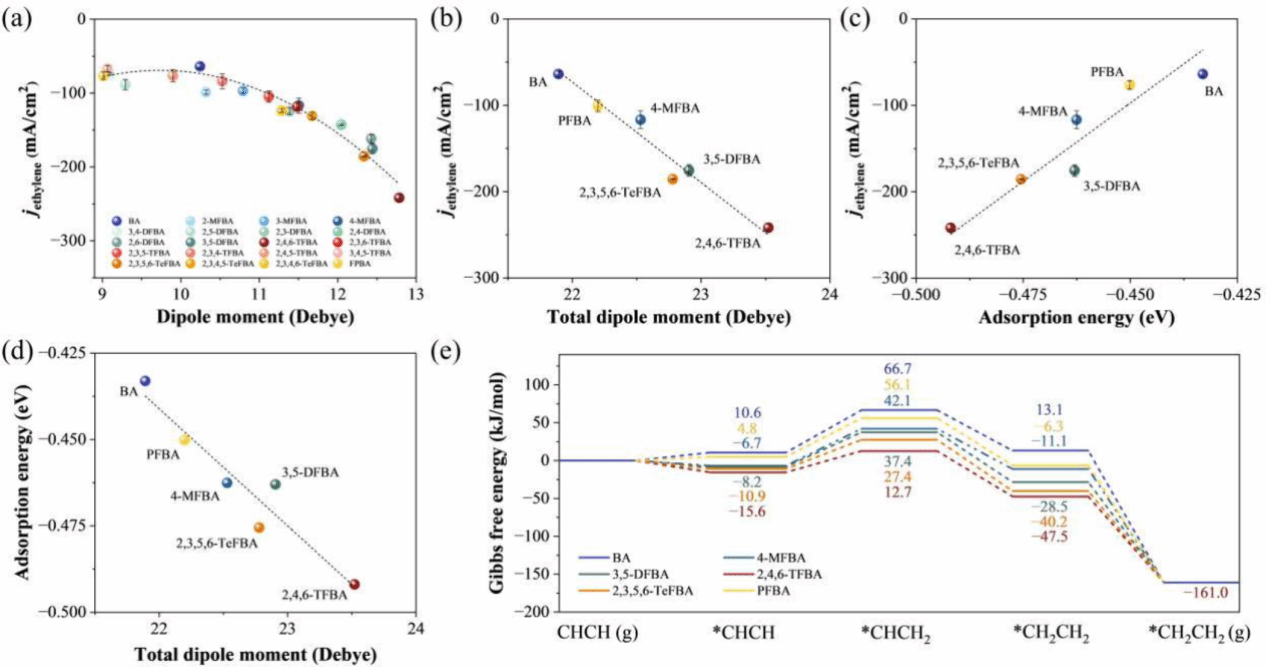
Figure 3. Theoretical calculations for FBA. (a) Correlation between ethylene partial current density and the dipole moment of BA and FBA. (b) Correlation between ethylene partial current density and the total dipole moment of acetylene adsorbed on BA, 4-MFBA, 3,5-DFBA, 2,4,6-TFBA, 2,3,5,6-TeFBA, and PFBA. (c) Correlation between ethylene partial current density and the acetylene adsorption energy of BA, 4-MFBA, 3,5-DFBA, 2,4,6-TFBA, 2,3,5,6-TeFBA, and PFBA. (d) Correlation between acetylene adsorption energy and the total dipole moment of BA, 4-MFBA, 3,5-DFBA, 2,4,6-TFBA, 2,3,5,6-TeFBA, and PFBA. (e) Gibbs free energy diagram for acetylene semihydrogenation into ethylene at 0 V vs RHE on BA, 4-MFBA, 3,5-DFBA, 2,4,6-TFBA, 2,3,5,6-TeFBA, and PFBA.