Cite this article:
Bai, R.#; Lin, J.#; Liu, C.; Ma, W.; He, J.; Zhou, S.; Yuan, M.*; Zhang, J*. Switching Hydrogen Transfer Pathway over Paddle-Wheel Dicopper Molecular Catalysts for Efficient Electrocatalytic Acetylene Semihydrogenation. Adv. Mater. 2026.
https://doi.org/10.1002/adma.73644
1.Introduction
Ethylene serves as a fundamental building block in the chemical industry and is widely used in the production of synthetic polymers such as rubbers, fibers, and plastics, as well as commodity chemicals like ethanol and vinyl chloride. The global output of ethylene currently reaches approximately 200 million tons. However, the cracking process inevitably introduces trace amounts of acetylene as an impurity into ethylene feedstocks produced via petroleum cracking, which can irreversibly poison the catalysts employed in downstream polymerization reactions. Consequently, the development of efficient and highly selective acetylene removal technologies is indispensable for the production of polymer-grade ethylene. In this context, room-temperature electrocatalytic acetylene semihydrogenation (EAH) using water as a proton source has emerged as a promising approach.
Currently, Cu-based catalysts have widespread attention for EAH. However, their catalytic performance is affected by multiple factors, including crystal facet, size, and defects, which makes the structure–activity relationship difficult to clarify. In addition, the EAH process predominantly proceeds through two classical mechanisms: the Langmuir-Hinshelwood (L-H) mechanism and the Eley-Rideal (E-R) mechanism. In the Langmuir-Hinshelwood mechanism, H2O first dissociates at the active sites to form active hydrogen (*H) species, which subsequently undergo electrophilic addition into adsorbed acetylene for semihydrogenation. In contrast, the Eley-Rideal mechanism involves the direct attack of H2O on adsorbed acetylene to feed protons. The L-H pathway is typically accompanied by the competitive hydrogen evolution reaction (HER), which severely undermines ethylene selectivity. Although the E-R mechanism can effectively suppress the HER, how to design catalysts that steer the reaction through the E-R pathway remains challenging.
2.Summary of Research Findings
Professor Jian Zhang’s group innovatively designed a series of paddle-wheel dicopper molecular catalysts and achieved precise modulation of the charge density of active Cu sites through ligand engineering based on acetic acid, benzoic acid, and monofluorobenzoic acid. It was found that the benzoic acid-Cu catalyst (BA-Cu), featuring a moderate charge density, reduces the C2H2 adsorption energy and inhibits H2O dissociation, thereby promoting the co-adsorption of C2H2 and H2O and steering the EAH process through the Eley-Rideal mechanism. At −0.9 V versus RHE, BA-Cu delivers an ethylene Faradaic efficiency of 96.4% and an ethylene partial current density of 328 mA/cm2 under pure acetylene atmosphere, which is about 2-fold and 1.4-fold higher than acetic acid-Cu (AA-Cu) and monofluorobenzoic acid-Cu (MFBA-Cu). This is because catalysts with either excessively low (AA-Cu) or excessively high (MFBA-Cu) charge density tend to facilitate H2O dissociation to generate active *H species, driving the EAH via the Langmuir-Hinshelwood mechanism accompanied by the competitive hydrogen evolution reaction (HER). This process was systematically corroborated by in situ differential electrochemical mass spectrometry (DEMS), in situ electrochemical FT-IR, radical quenching experiments, cyclic voltammetry (CV), and kinetic isotope effect (KIE) measurements, in combination with density functional theory (DFT) calculations. These results together reveal that the role of charge density in governing the hydrogen transfer pathway and the intrinsic advantages of the E-R pathway in suppressing the HER and overhydrogenation.
The research, titled “Switching Hydrogen Transfer Pathway over Paddle-Wheel Dicopper Molecular Catalysts for Efficient Electrocatalytic Acetylene Semihydrogenation” has been published in the top international materials journal Advanced Materials (DOI: 10.1002/adma.73644). The corresponding authors are Professor Jian Zhang and Associate Professor Menglei Yuan from State Key Laboratory of Solidification Processing and School of Materials Science and Engineering, and the first author is Ph.D candidate Rui Bai and Jin Lin.
3.Graphical Overview
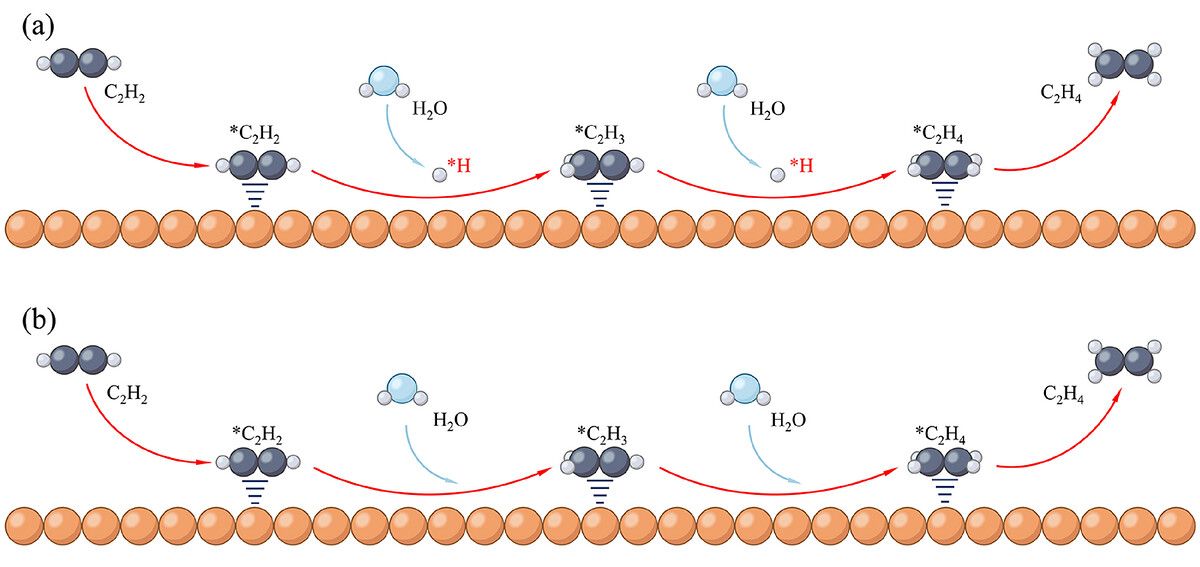
Figure 1. Schematic diagram of different hydrogenation mechanisms for EAH. (a) The Langmuir-Hinshelwood mechanism and (b) Eley-Rideal mechanism.

Figure 2. Structural characterization of the paddle-wheel dicopper molecular catalysts. Experimental and simulated XRD patterns of (a) BA-Cu, (b) MFBA-Cu, and (c) AA-Cu. (d) Cu K-edge XANES and (e) FT-EXAFS spectra of BA-Cu, MFBA-Cu, and AA-Cu using Cu foil, Cu2O, and CuO as references. The WT-EXAFS contour plots of (f) BA-Cu, (g) MFBA-Cu, and (h) AA-Cu using Cu foil, Cu2O, and CuO as references.
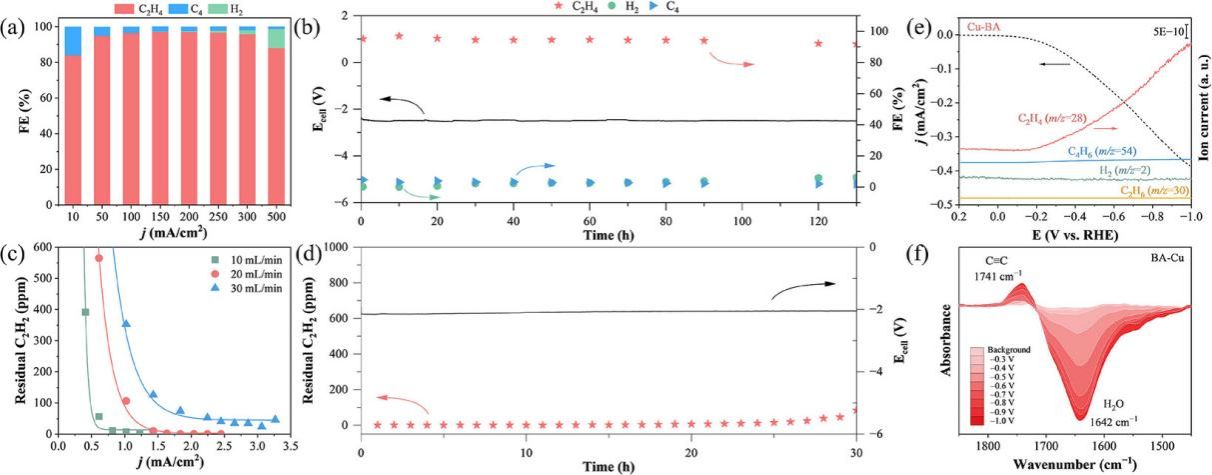
Figure 3. Electrocatalytic acetylene semihydrogenation performance of the paddle-wheel dicopper molecular catalysts in a two-electrode flow cell and in situ electrochemical characterization. (a) Faradaic efficiencies of BA-Cu at different current densities under pure acetylene flow in a two-
electrode flow cell with an electrode area of 1 cm2. (b) Electrocatalytic acetylene semihydrogenation stability of BA-Cu at 50 mA/cm2 under pure acetylene in a two-electrode flow cell with an electrode area of 1 cm2. (c) The minimum residual acetylene concentrations at different flow rates under crude ethylene flow (1% acetylene and 99% ethylene) in an enlarged two-electrode flow cell with an electrode area of 49 cm2. (d) Long-term stability test of BA-Cu in 20 mL/min crude ethylene flow at a current density of 2.04 mA/cm2. (e) In situ DEMS and (f) electrochemical FT-IR spectrums of BA-Cu during acetylene semihydrogenation.
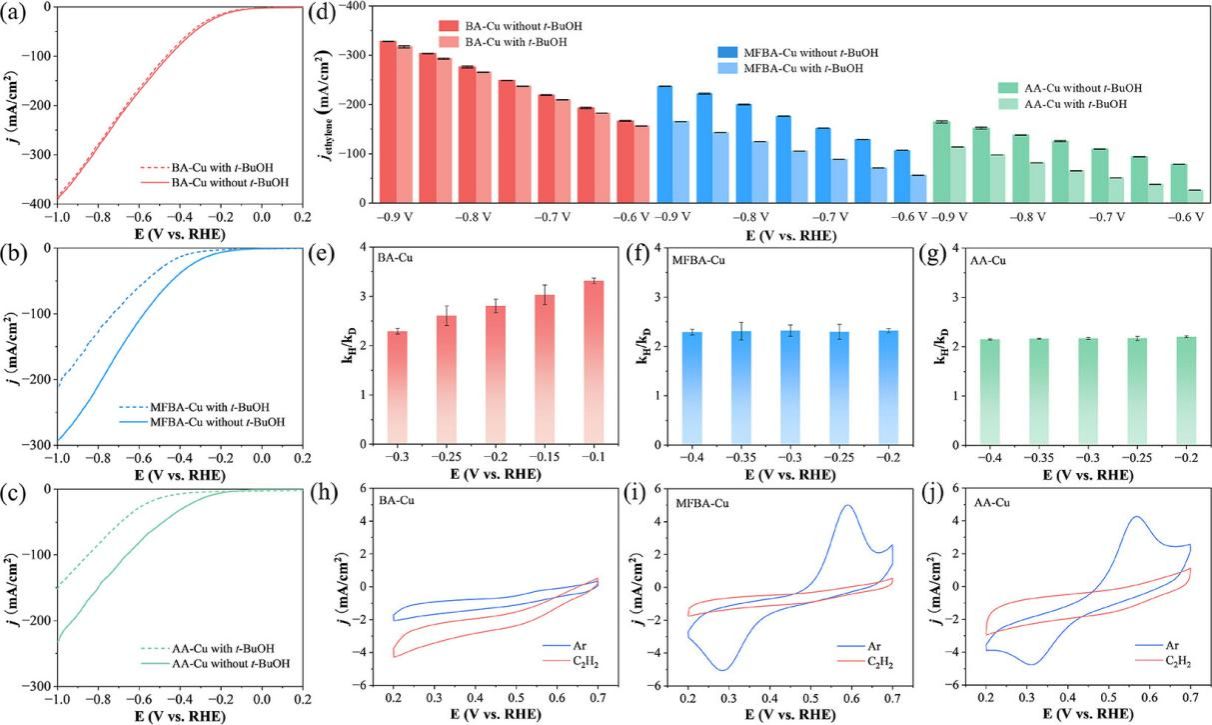
Figure 4. Mechanistic investigations. Polarization curves of (a) BA-Cu, (b) MFBA-Cu, and (c) AA-Cu under a pure acetylene flow in 1 M KOH aqueous solution with/without t-BuOH. (d) Comparison of Faradaic efficiencies for BA-Cu, MFBA-Cu, and AA-Cu under pure acetylene flow in 1 M KOH aqueous solution with/without t-BuOH. The KIE value of (e) BA-Cu, (f) MFBA-Cu, and (g) AA-Cu at various potentials. CV curves of (h) BA-Cu, (i) MFBA-Cu, and (j) AA-Cu under an argon and pure acetylene flow.